
Which Baseball Field Covers Outlast the Season (& the Competition)?
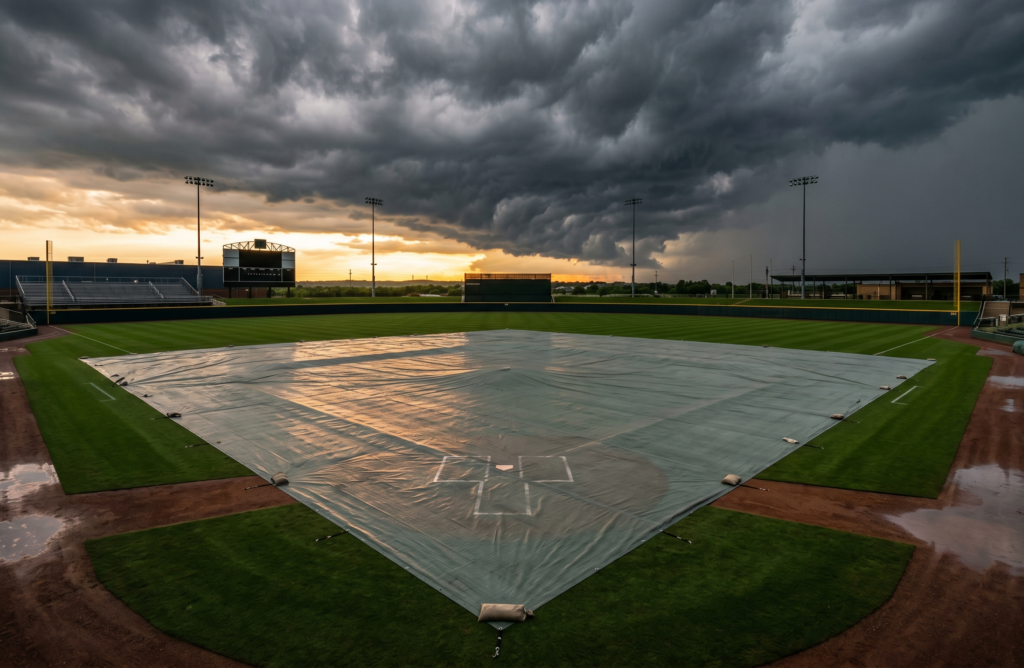
Every grounds crew knows the feeling: you pull back a tarp after an overnight downpour and find puddles pooling on the infield clay, the mound soft in all the wrong spots, and the batter’s box eroded beyond quick repair.
The right baseball field covers prevent that scenario entirely.
They keep moisture out, block UV damage, and shave hours off pregame prep, so your diamond plays the way it should from the first pitch of the season to the last out of playoffs.
But not all field cover materials are created equal. Traditional vinyl tarps are heavy, crack in cold weather, and end up in a landfill when they wear out. Recyclable thermoplastic composite fabrics offer the same weather protection at a fraction of the weight, with UV stability, and a closed-loop end-of-life path. Below, we break down what separates a field cover that lasts one season from one built with material that outlasts the competition.
7 Ways Better Baseball Field Tarps Keep Your Diamond in Top Shape
A quality baseball field tarp does more than keep rain off the dirt. It protects every high-traffic zone on your diamond (i.e. mound, plate area, basepaths, and grass edges) from the elements that degrade playing surfaces fastest.
Here are seven measurable ways the right tarp material pays for itself:
- Keeps moisture out of infield dirt and clay: Standing water softens infield mix and creates low spots that collect more water with every subsequent rain. A properly sized field cover sheds precipitation before it reaches the clay, keeping your soil profile firm and consistent.
- Prevents sun from baking and cracking the mound: Exposed clay dries unevenly under direct sunlight, leading to surface cracks that worsen with each game. A UV-stable cover blocks solar radiation and holds in just enough moisture to maintain the mound’s integrity between outings.
- Reduces pregame prep time after rain delays: When a tarp holds out the storm, your crew spends minutes on final grooming instead of hours on damage control. That faster turnaround protects your game schedule and reduces labor costs over a full season.
- Protects infield grass edges from cleat damage: Grass-dirt transitions are the first areas to thin out during a busy schedule. A cover keeps those edges from becoming saturated and soft, so cleats don’t tear up sod when players round the bases on a wet field.
- Extends the life of your playing surface between renovations: Annual resurfacing and resodding are major budget items. Consistent cover use slows surface degradation, which means longer intervals between full renovations and more dollars available for other facility needs.
- Shields the batter’s box from wind and weather erosion: Wind-driven rain and foot traffic combine to erode the batter’s box faster than almost any other area on the field. A spot cover or full infield tarp keeps that high-use zone stable and game-ready.
- Keeps your diamond game-ready from opening day through playoffs: Cumulative protection across an entire season is where a durable field cover delivers its biggest return. Fewer rain-outs, less repair work, and a consistently playable surface add up to a better experience for players, coaches, and fans.
Why Do Coaches & Grounds Crews Trust Our Field Cover Materials Season After Season?
Durability claims are easy to make. Third-party certifications are harder to earn.
Renegade’s thermoplastic composite fabrics have been tested against rigorous industry and regulatory standards, giving coaches and grounds crews confidence that the material inside their field cover will perform as promised, season after season, regardless of who fabricates the finished product.
Here are the credentials that back up our fabrics:
- NFPA-701: If your field cover application requires fire-propagation resistance, Renegade can supply fabrics that meet the NFPA-701 standard. Talk to our sales team to confirm which product fits your specific requirements.
- Cal Fire Marshal Title 19: For applications governed by California’s stringent Title 19 flammability requirements, Renegade offers fire retardant fabric options that can meet this standard. Our sales team can help you identify the right material for your project.
- CPSIA Component Compliance Testing: Youth baseball programs and school districts often require materials that meet CPSIA thresholds for heavy metals and phthalates. Renegade can provide fabrics that satisfy these requirements when they apply to your application.
- EU Toy Safety EN 71-3: When your project calls for compliance with the European Toy Safety Code EN 71-3 is one of the strictest migration-of-elements standards in the world, and Renegade has fabric options that can meet this benchmark. Contact our team to discuss your needs.
- Proposition 65 Compliance: If California’s Proposition 65 is relevant to your application, Renegade can supply fabrics that do not contain chemicals at levels requiring a warning label. Our sales team will help you find the right fit.
From Mound Covers to Full Field Tarps: 4 Fabrics That Actually Fit the Job
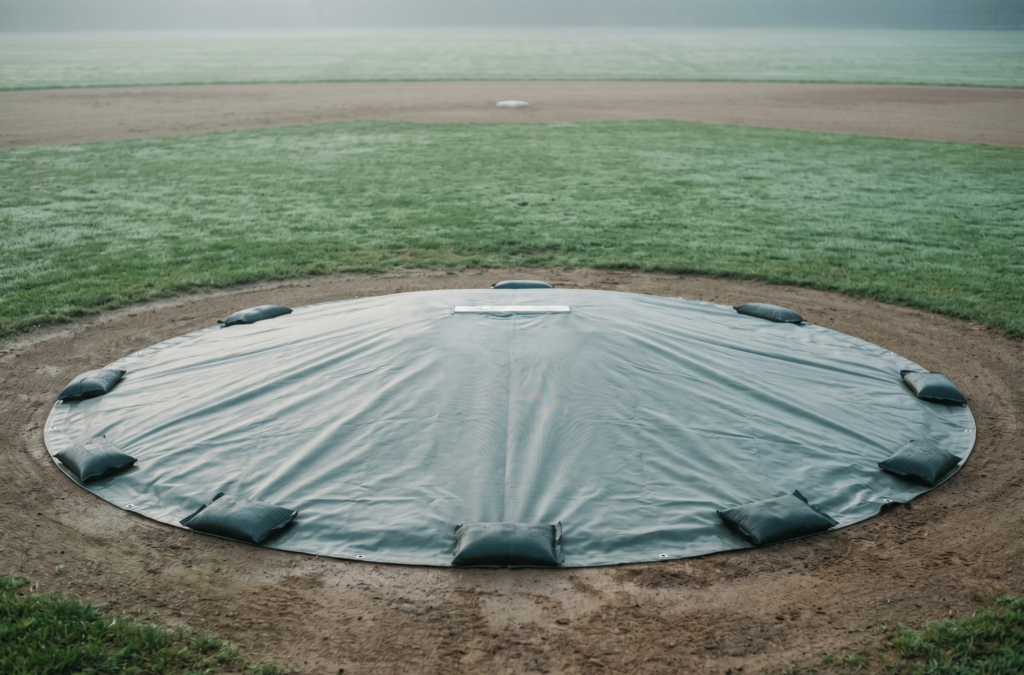
Not every cover on your field needs to be the same weight or construction. A lightweight mound tarp has different demands than a full infield cover that four crew members wrestle into position before a storm.
Renegade supplies a range of recyclable polypropylene fabrics, available in custom sizes, so you can match the material to the application without defaulting to one-size-fits-all vinyl.Here are five fabrics well suited to baseball field cover applications, from our lightest film-alternative sheet to our toughest water-contact composite:
At 5.9 oz. per square yard, the PPI-200 is Renegade’s lightest 3-ply fabric. Its 20×20 thread density delivers a smooth finish at just 11 mil thick, making it ideal material for lightweight spot covers over the mound or batter’s box where easy handling is the priority.
Weighing 7.7 oz. per square yard with superb strength properties, the PPI-270 replaces 10- to 12-ounce PVC fabrics. It is UV stable and available in fire retardant versions that comply with Cal Fire Marshal Title 19: a solid material choice for mid-duty field covers at schools and public parks.
Renegade’s workhorse fabric at 11.2 oz. per square yard, the PPI-370 replaces 16- to 18-ounce vinyl. Its lighter weight makes it well suited to full infield tarps and batting practice collar covers where easier deployment matters.
Built for constant water contact, the Hydro-370 features an integrated BOPP liner that adds a reliable moisture barrier and delivers nearly twice the abrasion life of the PPI-370. It is an excellent material choice for covers that sit on wet surfaces for extended periods.
Full Field or Spot Cover? How to Size Your Infield Tarps & Mound Covers Correctly
Sizing a baseball field cover starts with knowing exactly what you need to protect:
- A full infield tarp typically runs 160 feet across the basepaths and needs enough overhang to anchor securely in wind.
- Spot covers for the mound, home plate, or batter’s box are smaller and quicker to deploy, but they still need to be cut to the right dimensions so water doesn’t pool at the edges or funnel underneath.
Renegade supplies custom-cut fabric in a wide range of sizes and can help you find the right material solution for your specific application. Whether you need lightweight material for a regulation 20-foot mound cover, heavy-duty composite for a full infield tarp, or something in between, our team will work with you on material selection and sizing. Contact our sales team to discuss your field’s requirements and get a quote on the right fabric for your covers.
| Cover Type | Field Level | Recommended Size |
| Full Infield Tarp | Little League / Youth | 90′ × 90′ |
| Full Infield Tarp | Softball | 120′ × 120′ |
| Full Infield Tarp | High School / College Baseball | 160′ × 160′ |
| Full Infield Tarp | Professional / MLB | 170′ × 170′ |
| Skin / Infield Tarp | Regulation Baseball | 160′ × 160′ (matched to infield cut) |
| Skin / Infield Tarp | Little League | 90′ × 90′ (matched to infield cut) |
| Mound Cover | Youth / Little League | 12′ diameter |
| Mound Cover | High School / College / Pro | 20′ diameter |
| Home Plate Cover | Youth / Little League | 18′ diameter |
| Home Plate Cover | High School / College / Pro | 26′ – 30′ diameter |
| Base Cover | All Levels | 10′ × 10′ |
| On-Deck Circle Cover | All Levels | 10′ – 12′ diameter |
| Batting Practice Collar | All Levels | Custom to cage footprint |
From Batting Practice to Winter Protection: 8 Baseball Field Cover Applications That Extend Field Life
A field cover earns its investment by serving multiple purposes throughout the year, not just on game days. From daily moisture management to off-season protection, here are eight applications where choosing the right cover material makes a measurable difference in field longevity:
- Rain delay infield protection: Deploying a tarp at the first sign of rain keeps the infield mix playable and cuts postgame restoration time significantly.
- Pitching mound moisture retention between games: A mound cover locks in the right moisture level between outings, preventing the cracking and crumbling that come from repeated wet-dry cycles.
- Home plate and batter’s box spot coverage: Targeted spot covers keep the highest-traffic areas of the field stable and reduce the frequency of between-game clay repairs.
- Batting practice collar and turf protection: Covering the grass collar around the infield during batting practice prevents cleat damage and divots in areas that are expensive to resod.
- Overnight cover after irrigation: Post-irrigation covers hold moisture in the soil profile overnight and prevent evaporation, so your watering schedule actually delivers the results you planned.
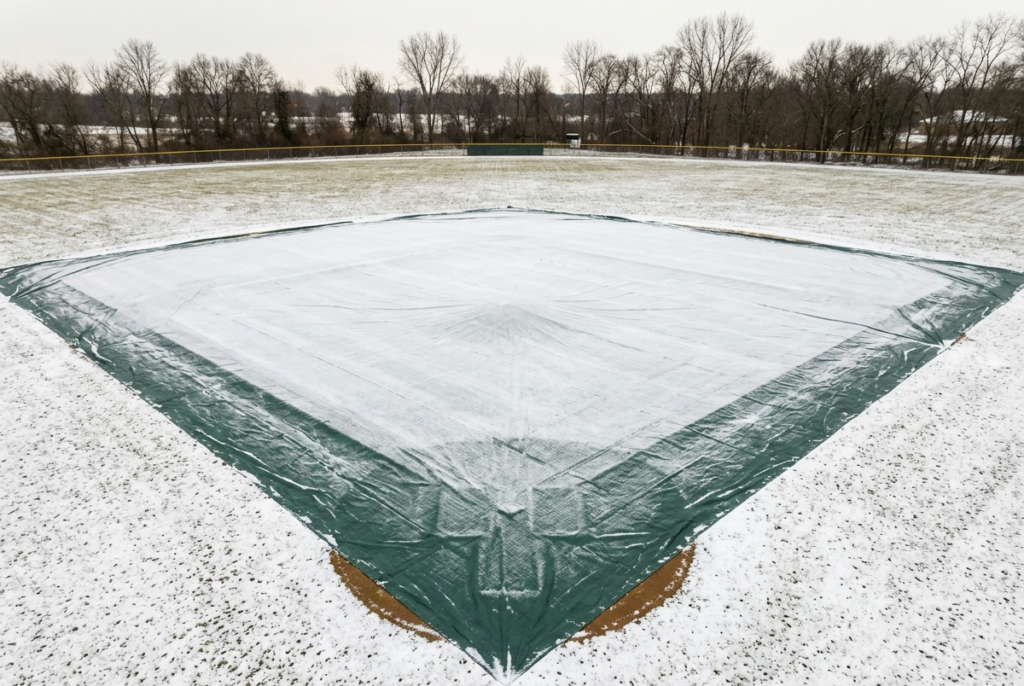
- Off-season winter field protection: A winter cover shields the playing surface from freeze-thaw cycles, ice accumulation, and debris, reducing the scope of spring renovation work.
- Early spring frost and freeze prevention: Deploying covers on cold nights in early spring protects newly seeded grass and freshly graded clay from frost heave and ice crystal damage.
- Event conversion turf protection: When your field hosts non-baseball events (i.e. concerts, ceremonies, community gatherings), a cover protects the turf from foot traffic, equipment, and staging.
5 Baseball Field Tarp Questions Coaches & Grounds Crews Ask Us Most
We talk to coaches, athletic directors, and grounds crews every week about choosing the right material for their field covers. These are the questions that come up most often, along with straight answers from our team:
- How do I anchor a baseball field tarp in high winds without damaging the edges? Use weighted sandbags or rubber-coated anchors spaced evenly around the perimeter rather than stakes that can tear grommets. Reinforced hems and D-ring attachment points distribute wind load more evenly and extend the life of the tarp’s edges.
- Can the same fabric work for both natural grass and artificial turf fields? Yes. Renegade’s polypropylene fabrics are non-marking and chemically inert, so they won’t stain, discolor, or degrade synthetic turf fibers. The same material works on natural grass without trapping excessive heat the way dark vinyl can.
- How many people does it take to deploy and remove a full infield tarp? A typical full infield tarp requires a crew of six to ten people for efficient deployment. Covers built with Renegade’s lighter-weight polypropylene fabrics reduce that labor demand compared to heavier vinyl tarps, making faster pulls possible with fewer hands.
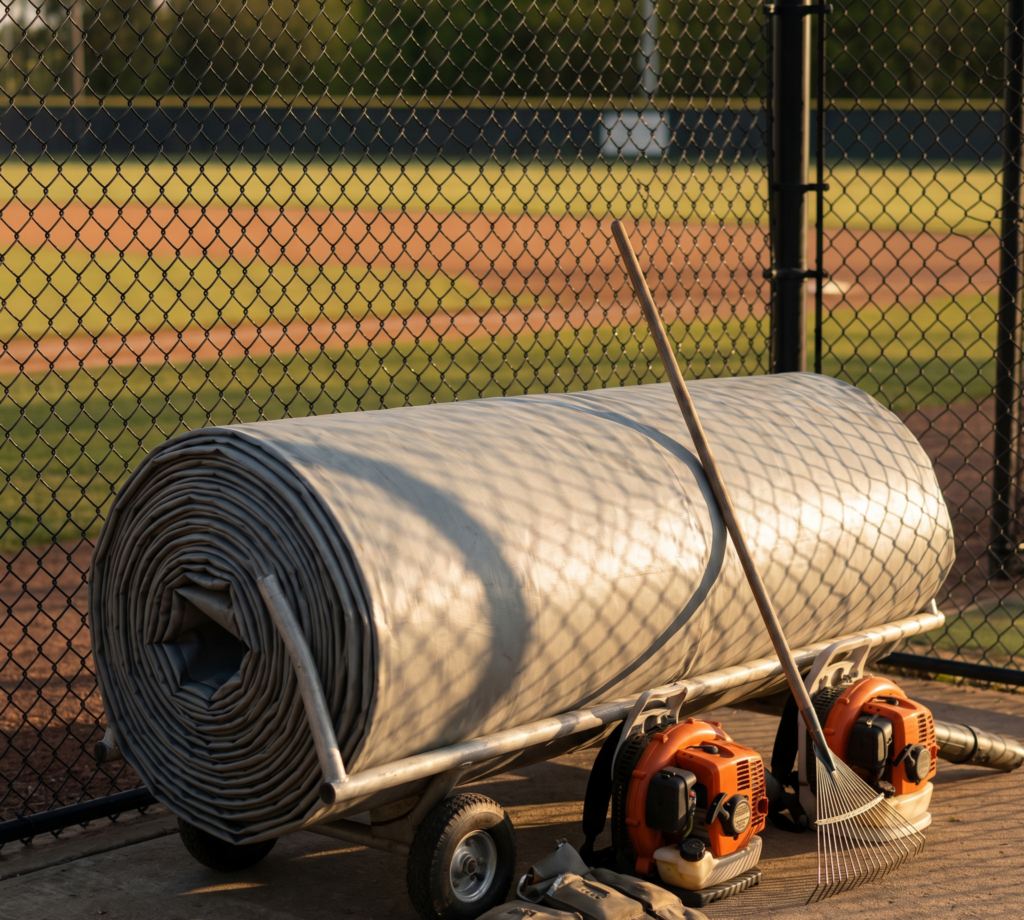
- What’s the best way to dry and store a baseball field cover between uses? Spread the cover on a dry surface or drape it over a fence to air-dry before rolling. Store rolled covers off the ground in a shaded, ventilated area to prevent mildew and UV degradation during the off-season.
- How do polypropylene field covers hold up compared to traditional vinyl tarps over multiple seasons? Polypropylene composites resist UV degradation, maintain flexibility in cold weather, and don’t crack or stiffen the way PVC-coated fabrics do after repeated freeze-thaw cycles. The result is a cover that stays workable and watertight across multiple seasons… and is fully recyclable when it finally reaches end of life.
Ready to Protect Your Infield Grass With Field Covers That Actually Last?
Your field deserves a cover built from material that performs like the players on it:
- Consistently
- Reliably
- Without excuses
Renegade’s recyclable thermoplastic composite fabrics deliver the weather protection and durability of traditional vinyl at a lighter weight, with the added advantage of being fully recyclable at end of life. Whether you need material for a single mound cover or a full suite of infield tarps, we can help you find the right solution for your application.
Contact our team today to request fabric samples, discuss your sizing needs, or get a quote on the right material for your baseball field covers.