
Black Mesh Fabric That’s Tougher Than It Looks ( & Safer Than What You’re Using Now
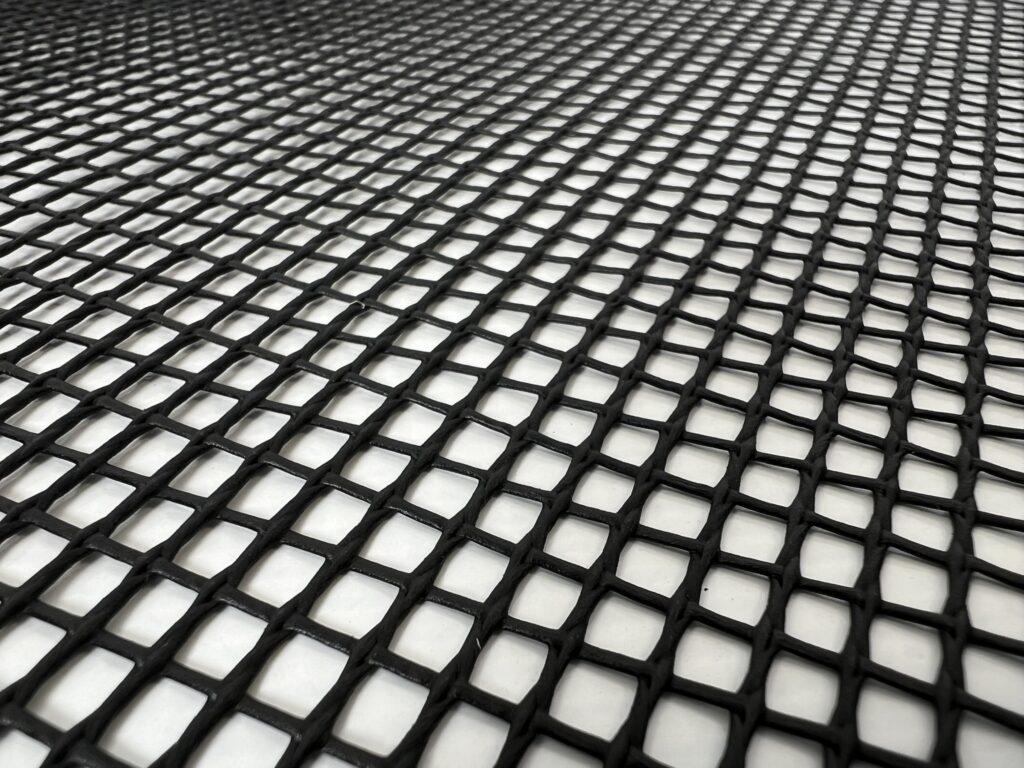
Most black mesh fabrics sold for industrial and commercial use carry a California Proposition 65 warning. That label isn’t incidental paperwork; it’s the chemical fingerprint of vinyl-coated construction.
The PVC coating that gives rigidity to traditional mesh also has some dangerous side effects:
- It off-gasses volatile organic compounds.
- It contains plasticizers that migrate out of the material over time.
- In older formulations, it includes lead-based stabilizers.
Many facilities that order these mesh fabrics for machine guards, warehouse curtains, or shade structures accept these trade-offs without knowing a different chemistry is available.
Let’s explore those alternatives so that you can make the most informed decision for your company.
We’ll delve into the specifics of our Mesh-215, which is built from polypropylene instead of PVC or polyester. That base material change touches almost every property that matters for professional use (chemical safety, cold-temperature behavior, UV stability, and end-of-life recyclability) and it does so at ~6 oz per square yard, roughly 40% lighter than the 10 oz fabrics that dominate the traditional mesh market.
How to Choose a Black Mesh Fabric: Why the Base Material Matters More Than the Spec Sheet
In contrast to many traditional materials, polypropylene holds a few key advantages:
- It doesn’t absorb water.
- It doesn’t off-gas VOCs.
- It doesn’t contain the phthalates or lead-based stabilizers that produce Prop 65 warnings on PVC products.
This is why polypropylene is the base material for food containers, medical packaging, and aquatic applications worldwide. These properties aren’t added through a surface coating; they’re intrinsic to the polymer chemistry, which means they don’t degrade or wear off over the product’s service life.
That same chemistry explains our Mesh-215‘s cold-temperature behavior. PVC becomes brittle below 32°F because the plasticizers that give it flexibility begin to solidify. A machine guard or warehouse curtain made from PVC mesh develops micro-cracks during a Midwestern winter — small failures that compound into panel failure when someone brushes past it at 0°F.
Polypropylene maintains flexibility across a wider temperature range, which means our black mesh fabric performs the same way in January as it does in July. For any facility running cold storage, outdoor operations, or applications where fabric gets handled in freezing conditions, that temperature stability is the difference between a panel that lasts one season and one that lasts a decade.
UV degradation is the other failure mode that traditional mesh buyers plan around. Polyester-based mesh loses tensile strength and color stability under sustained UV exposure, which drives 2-3 year replacement cycles in outdoor applications. Our UV stabilizers are incorporated during fiber manufacturing, rather than applied as a surface treatment (because surface treatments wear off). The stabilizers in the fiber itself don’t.
Why is Weight Class a Top Priority When Choosing a Mesh Fabric?
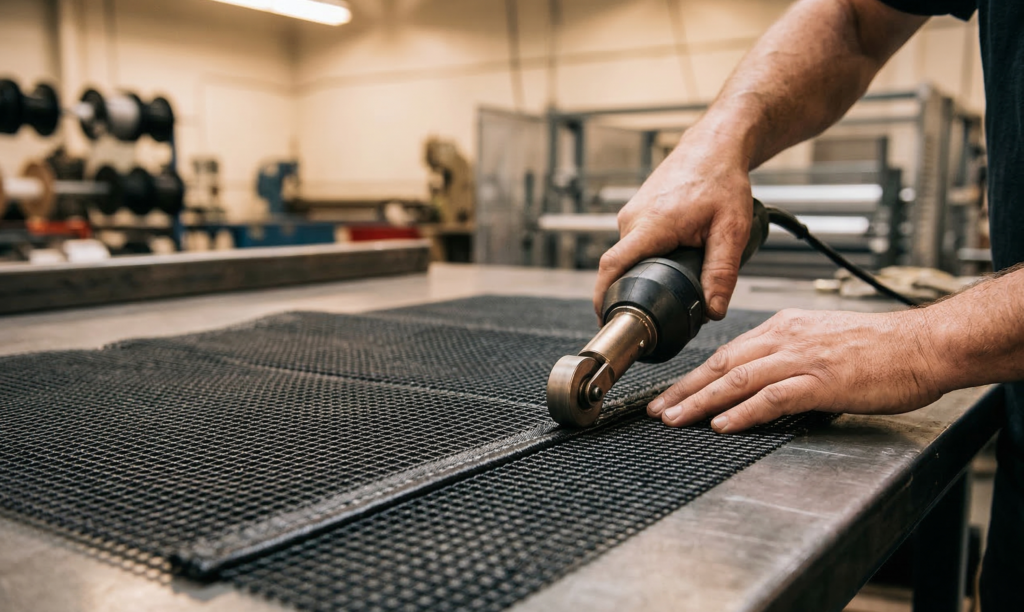
At 215 g/m² (~6 oz/yd²), Renegade’s Mesh-215 is in a weight class that most mesh suppliers don’t occupy. Traditional industrial mesh clusters around 10 oz per square yard: a weight driven by the mass of PVC coating required to achieve the rigidity those products advertise. The lighter weight of polypropylene construction creates compounding practical advantages:
On the installation side, a crew hanging a 40-foot warehouse curtain from 10 oz fabric manages significantly more dead weight than one working with ~6 oz equivalent. The hardware required to support that dead weight scales accordingly: heavier tracks, more robust mounting hardware, more labor per linear foot. Lighter fabric means lighter hardware and faster installation, and those savings compound across large projects.
Also, shipping cost scales directly with weight per yard. For buyers purchasing in volume, the per-yard weight difference between our black mesh fabric and a 10 oz competitor often narrows the price gap meaningfully… sometimes enough to offset it entirely.
5 Additional Benefits of a Superior Black Mesh Fabric
When you select a smarter material for your mesh, the result is function without compromise, and results you can depend on. Here are a few prominent examples:
- Proper Weave Density: Our 6×6 weave (six yarns per inch in both directions) creates a consistent, open aperture structure that balances airflow, visibility, and tensile strength. This weave density is stiffer than knit mesh, which stretches and distorts under sustained load, but more open than a solid barrier fabric.
The result works as a machine guard without creating a dead-air pocket, as a shade panel without eliminating natural light, and as an agricultural windbreak without generating the sail effect that collapses tensile-mounted structures in high winds. - Heat Weldable and Sewable: Both thermal and ultrasonic welding on the Mesh-215 produce clean seams, which gives fabricators options that sew-only materials can’t offer. Welded seams distribute stress more uniformly than stitched seams under tension, which matters in high-wind applications like windbreaks, shade structures, and outdoor sports facility screening.
- Bleach and Solvent Resistant: A top-tier material like Renegade’s black mesh holds up to the industrial cleaning protocols common in food processing, healthcare, and commercial kitchen environments without surface degradation.
- NFPA 701 Approved: Their Test Method #2 rating, which our fabric meets, covers both indoor and outdoor applications, and it’s the standard referenced by commercial construction, warehouse safety specifications, mining operations, and any project where a textile barrier requires third-party flame-resistance verification.
A mesh fabric that meets this standard at ~6 oz per square yard used to require a trade-off: certified performance or practical workability. Ours doesn’t. - Recyclable: Renegade also manufactures a non-fire retardant version for applications where an NFPA 701 rating isn’t required. Unlike the FR version,which needs a facility equipped to process polypropylene with fire retardant additives,the non-FR version is fully recyclable through most standard polypropylene recyclers.
For buyers with sustainability mandates or end-of-life recycling targets, that distinction matters: the non-FR option delivers a cleaner material loop than any PVC or polyester-based mesh, with no mixed-material construction to complicate the recycling stream.
Frustrated by Fabrics That Can’t Compete? Choose Renegade
Renegade Plastics builds industrial materials from the ground up, starting with the base polymer, not the coating. Every fabric in the lineup is engineered to eliminate the failure modes that make traditional mesh a recurring line item: delamination, cold cracking, VOC exposure, and landfill-bound disposal at end of life.
That philosophy shows up in every yard of Mesh-215.
If your current mesh spec is creating maintenance cycles you’d rather not manage, the Renegade sales team is ready to help you find a better fit. Contact us to request a sample, discuss custom sizing, or get a quote for your next project.
7 Professional Environments That Require a Higher Caliber of Durable Mesh Fabric
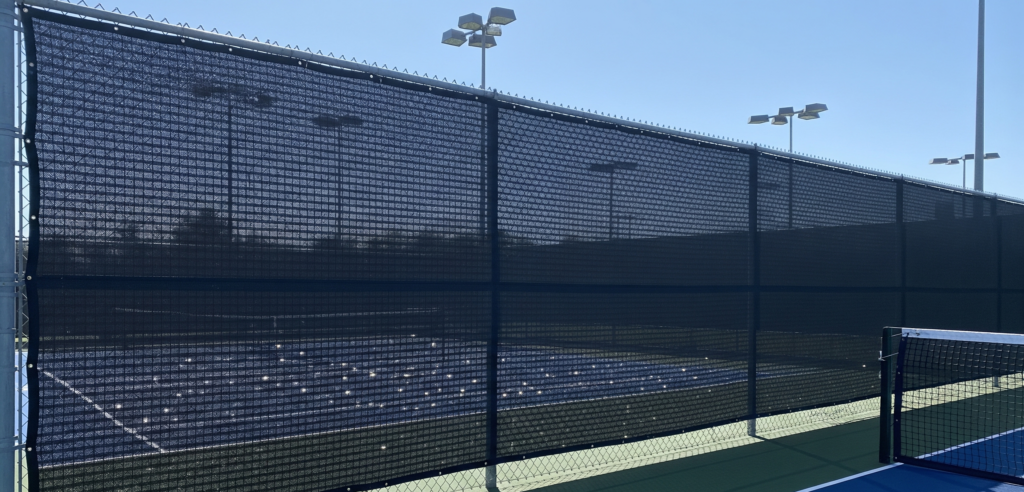
The applications that benefit most from our black mesh fabric’s property profile are the ones where traditional PVC mesh creates recurring maintenance problems.
- Mining operations use mesh barriers for dust suppression and equipment screening in environments where cleaning agents, moisture, and temperature swings cycle continuously. Delamination (where the PVC coating separates from its polyester substrate) is a common failure mode in these conditions. Polypropylene’s single-material construction has no coating layer to separate, because the material is the same all the way through.
- Construction and industrial safety netting requires fabric that can be deployed, repositioned, and redeployed without losing structural integrity. Mesh-215‘s lower weight makes it more practical to handle on scaffolding and at height, where material weight directly affects worker safety and installation time.
- Athletic facilities (such as outdoor courts, training fields, sports complexes) run through traditional windscreen fabric on 3-5 year replacement cycles. UV degradation and seam failure drive most of those replacements. Renegade’s UV-stable construction and weldable seams address both failure modes directly.
- Restaurant sidewalls, shade sails, and commercial awnings require a fabric that looks acceptable throughout its entire service life. PVC coatings yellow and crack under sustained sun exposure; polypropylene with UV stabilizers holds color and flexibility longer. The same panel that looks clean and professional at installation looks the same three years later.
- Warehouse curtains and machine guards in manufacturing facilities need a material that doesn’t introduce air quality concerns in enclosed spaces. A fabric that doesn’t contribute to VOC load simplifies OSHA compliance for facilities where air quality standards are actively monitored. This matters most in food manufacturing, pharmaceutical production, and any enclosed space with regulated ventilation requirements.
- Marine applications add moisture resistance to the list. Polypropylene’s non-absorbent chemistry means panels won’t retain water weight, won’t support the mold growth that polyester mesh is prone to in persistent moisture environments, and won’t develop the brittleness that waterlogged PVC exhibits after freeze-thaw cycles.
- Agricultural windbreaks need to survive seasons of UV exposure, precipitation, and wind loading without annual replacement. Mesh-215‘s outdoor NFPA 701 rating combined with its UV stability makes it a viable multi-season solution rather than a consumable.
4 Critical Criteria to Check When Evaluating Any Mesh Fabric
The mesh market has enough product variation that a weight-per-yard number or a color match tells you almost nothing about how a fabric performs at 18 months. These are the specifications that separate adequate mesh from one you won’t need to replace:
- Cold-Temperature Flex: If a supplier doesn’t specify a brittleness temperature or flex retention in cold conditions, the PVC plasticizers almost certainly harden below freezing. Ask for data, not a claim.
- Chemical Resistance: Specifically to bleach and industrial solvents. A fabric that can’t confirm solvent resistance will degrade with any cleaning protocol beyond water, which rules it out for most commercial and industrial environments.
- Third-Party Fire Certification: NFPA 701 and equivalent standards require independent lab testing. “Flame resistant” without a specific standard reference means the manufacturer made that claim without independent verification. The certificate should name a testing laboratory and a specific test method.
- Material Safety Data: California Prop 65 warnings on mesh fabric almost always indicate the presence of phthalates or lead-based stabilizers. Legally permitted, but worth confirming before specifying the product for enclosed environments or any application where occupant exposure is a concern.
Still Have Questions About Black Mesh Fabric? Here Are the Answers That Matter
Whether you’re spec’ing for industrial safety or high-tension architectural installs, getting the technical details right is the difference between a project that lasts and one that fails. We’ve compiled the essential performance data on Mesh-215 to help you choose the right material for your specific environment.
- How does woven mesh compare to knit mesh? Woven mesh interlaces yarns at right angles, creating a rigid grid structure with fixed, consistent apertures. Knit mesh loops yarns together, producing a more flexible but stretchable material that distorts under sustained tension. For structural applications where consistent aperture geometry matters (machine guards, curtains, safety barriers, etc.)woven construction is more stable.
- What widths does Renegade stock? Standard width is 61″. Custom widths up to 3.2 meters are available through custom slitting for a small service fee. Standard stock ships from Green Bay within a few business days.
- How does Mesh-215 compare to standard netting? Renegade’s coated mesh is more rigid than conventional netting and carries a higher fire retardant certification. Netting works for light-duty applications; it’s not the right specification for installations that reference NFPA 701 or require structural consistency under load.
- Can Mesh-215 be thermally welded? Yes, thermal and ultrasonic welding both work. This gives fabricators the option of welded seams without sewing, which produces more uniform stress distribution in tension-mounted applications.
- How does Mesh-215 perform in wet or high-humidity environments? Polypropylene is one of the most common materials in aquatic and food-grade applications because it doesn’t absorb water. Mesh-215 won’t retain water weight, won’t support mold growth, and won’t lose structural integrity in humid or wet environments.
- What are typical lead times for bulk orders? Renegade maintains several thousand yards in Green Bay. Standard orders ship within a few business days. Larger custom orders (non-standard widths or colors) typically run 40 to 60 day lead times.
A Different Starting Question to Help You Procure the Best Mesh Fabric
The standard procurement question for mesh fabric is whether a cheaper product is ‘good enough.’ That framing leads to a predictable outcome: a Prop 65-labeled fabric that stiffens in cold, requires replacement in two years, and goes straight to a landfill when it does. The better question is what failure mode you’re trying to avoid:
- Cracking in a cold warehouse
- Delamination in a chemical environment
- UV degradation in an outdoor shade structure
- The recurring labor cost of cycling through replacements every other season
Renegade carries several thousand yards of Mesh-215 in stock at our warehouse in Green Bay, WI. Request a sample, run it against your current specification, and test specifically for cold-temperature flex and seam behavior under tension. Those two tests separate the field faster than any data sheet will.
Ready for a better material that can meet the demands of your industrial application? Contact us or call us at (920) 348-4554 to get a quote.