
Score Yourself a Win: How Smarter Fabric Choices Are Redefining Sports Field Covers
There is a specific moment every grounds crew director knows…
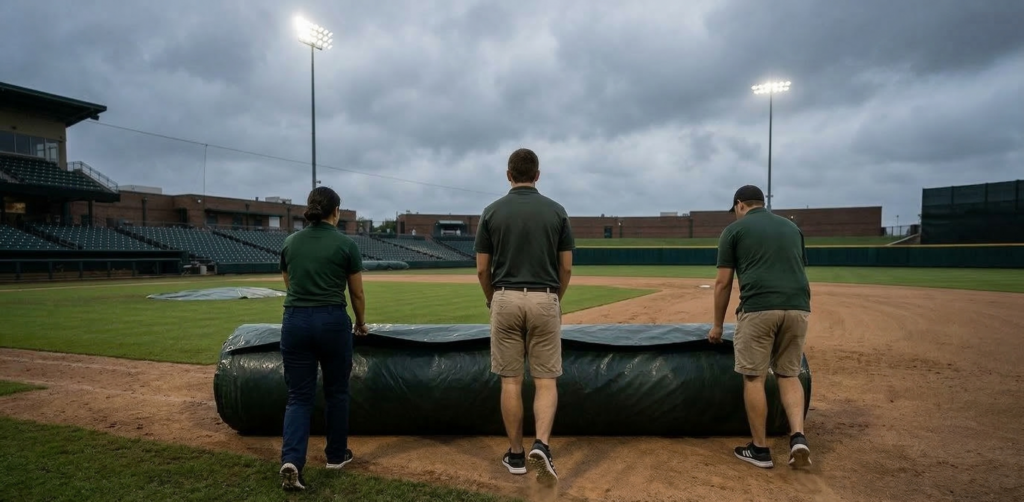
Rain is moving in, the game starts in 40 minutes, and the tarp crew is pulling a 160-pound vinyl cover across a wet infield under stadium lights. The cover gets down. The field is protected. But two workers are spent, a seam blew out at the third-base corner during last month’s rollout, and the cover shed its vibrant color two summers ago.
The field is fine. The cover is not.
Field cover manufacturers have been solving the wrong half of this problem. The industry has spent decades optimizing deployment systems (rollers, storage carts, securing loops) while the base fabric has stayed largely unchanged: PVC-coated polyester, heavy by design, with a performance ceiling defined by what vinyl can and can’t do. That ceiling is lower than most buyers realize until a cover fails mid-season.
This article is written for manufacturers who build field covers, tarps, and turf protection products. The argument is straightforward: the fabric choices available for your next product generation are meaningfully better than what the market has been running on, and your customers (grounds directors, athletic directors, facilities managers) will notice the difference in the first deployment.
3 Reasons Why Field Cover Performance Starts at the Fabric Level
A field cover is only as good as its weakest failure mode. For most covers built on traditional PVC-coated fabric, there are three:
- Weight at deployment: An 18 oz vinyl cover for a standard baseball infield can exceed 150 pounds. That weight lands directly on your grounds crew, and it compounds: wet vinyl is heavier, cold vinyl is stiffer, and fatigued crew members make seam-pulling errors that damage the cover likelier than weather does.
Weight is not a neutral specification. It determines how fast protection can be deployed, how reliably it happens under time pressure, and how many people it takes to do it safely. - Cold-weather stiffness: PVC plasticizers harden below freezing. A cover that stores in an outdoor shed in January and gets deployed in a snowstorm will flex less than it did when it was new. That reduced flexibility accelerates seam stress and edge cracking: two failure modes that compound across seasons until the cover can no longer hold water properly along its perimeter.
- Coating delamination: PVC-coated polyester is a layered construction: a polyester substrate with vinyl applied to both faces. Those layers are bonded, not fused. Under sustained UV exposure, repeated abrasion from infield drag rollers, and the freeze-thaw cycling common in northern climates, the coating separates from the substrate. When it does, water infiltration follows. The cover looks intact; it isn’t.
None of these failure modes are inevitable. They are properties of the material, which means they are addressable at the specification stage, before a single yard of fabric is cut.
Below is a table that describes how different types of materials for field covers affect the performance of the field cover:
| Attribute | Renegade Sports Field Covers | Generic Field Covers |
| Material Strength | High-strength coated polypropylene with engineered reinforcement | Standard tarp fabric with inconsistent weave tensile strength |
| Weather Protection | Superior rain, snow, and UV resistance for prolonged exposure | Limited weather resistance; degrades faster under sun and moisture |
| Tear & Abrasion Resistance | Engineered to resist tearing, punctures, and field friction | Tears readily with repeated deployment |
| Installation Ease | Intuitive, crew-friendly handling and deployment | Bulky, heavy, hard to manage |
| Longevity (Seasons) | Multi-season service life with proper care | Often requires replacement after one season |
| Storage Durability | Retains flexibility and performance after storage | Material becomes brittle, mildew develops |
| Total Cost of Ownership | Lower long-term cost due to durability | Appears cheaper upfront but costs more over time |
| Sustainability & Recyclability | Non fire-retardant field covers made with Renegade materials can be recycled either by Renegade or a Renegade recycling partner. | Limited. |
What Changes When You Build Sports Covers with Polypropylene Materials (4 Top Recommendations)
Renegade’s fabric lineup is polypropylene-based, not PVC. The base polymer difference is not incremental; it changes the performance profile in ways that matter specifically for field cover applications.
The lineup spans 5.9 oz to 11.7 oz per square yard across smooth and embossed surface options, which means manufacturers can match fabric weight and surface texture to cover function rather than defaulting to a single heavy-duty specification across their entire product line.
- PPI-200 (5.9 oz/sq.yd): PPI-200 is Renegade’s lightest 3-ply fabric: a replacement for up to 10 oz PVC coated and laminated fabrics. At 11 mil thick with a 20×20 thread density, it can replace engineered polyethylene films in some applications.
For field cover manufacturers, this is the specification for products where minimum weight is the primary design requirement: practice covers, temporary event protection, lightweight sideline mats, and any cover a single person handles alone. - PPI-270 (7.7 oz/sq.yd): PPI-270 replaces 10 to 12 oz PVC fabrics at nearly half the weight of traditional heavy-duty covers. UV stable and fish grade (OECD 203 Acute Toxicity). Fire-retardant versions comply with California Fire Marshal Title 19 and meet European Toy Safety Code EN71-3 2019, a viable specification for covers used in multi-purpose venues and indoor facilities with FR requirements.
- PPI-370 (11.2 oz/sq.yd) and PPI-420 (11.7 oz/sq.yd): PPI-370 and PPI-420 are Renegade’s workhorse coated fabric lines: replacements for 16 to 18 oz vinyl fabrics at a 35-40% weight reduction. Both cut, weld, and seam cleanly. A cover built on either fabric maintains the same cold-weather flexibility in February as it had in September: the stiffness characteristics that make heavy PVC covers difficult to deploy in winter are absent by design.
- Hydro-370 (11.2 oz/sq.yd): Hydro-370 is built for applications where water contact and abrasion are the primary stress conditions (which describes every field tarp that gets dragged across infield dirt and left on a wet grass surface overnight). Its integrated BOPP liner delivers approximately 2× the abrasion life compared to PPI-370 (ASTM D3389), with stronger burst performance for hard-use applications.
All fabrics in the Renegade lineup are polypropylene-based, which eliminates several downstream concerns: no Prop 65 warning for phthalates or lead-based stabilizers, no VOC off-gassing in enclosed storage, and a cleaner end-of-life path than PVC-coated polyester.
Surface Traction for Various Event Covers: 2 Embossed Fabrics Options
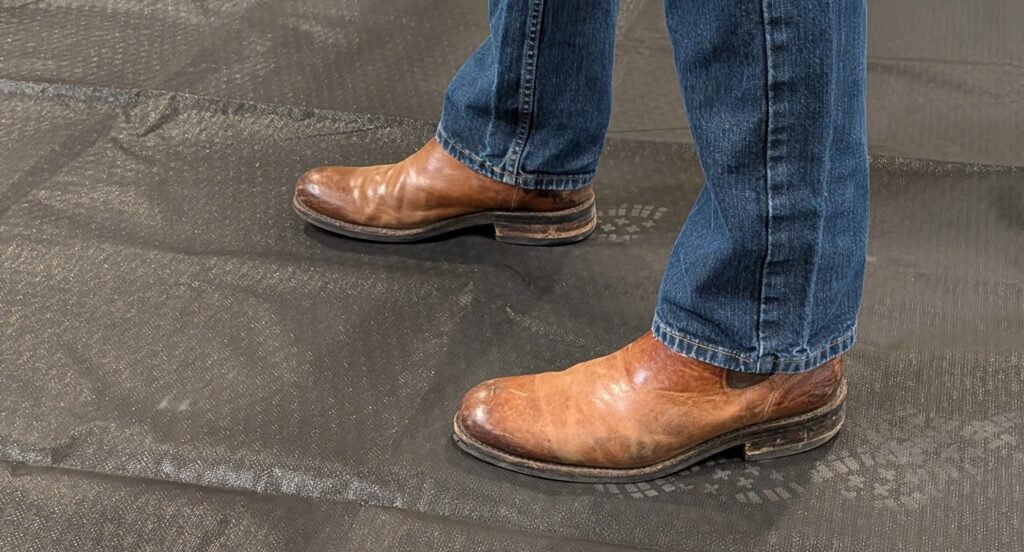
Weather protection is the primary function of a field cover. For event conversion covers ( deployed during concerts, graduations, trade shows, and other venue events held on natural or synthetic turf), a second performance requirement becomes equally important: surface traction.
Crew members deploying and repositioning covers, event staff and attendees walking on covered surfaces, and athletes warming up on sideline mats all need reliable footing. A smooth coated fabric in a wet outdoor environment does not provide it.
Renegade addresses this with two embossed-surface options that carry the same polypropylene base chemistry as the rest of the lineup.
- PPI-370 Embossed (11.2 oz/sq.yd): PPI-370 Embossed delivers an engineered embossed surface for reliable anti-slip performance at the same weight as the standard PPI-370. Designed for applications where footing and stability matter (sports mats, fitness flooring, equipment covers, industrial work surfaces), it replaces traditional 16 to 18 oz vinyl fabrics at a fraction of the weight.
For field cover manufacturers, this is the specification for any event conversion product that gets walked on: full-field event covers, concert venue turf protection, and multi-day sideline matting at high-traffic facilities.
- Flex-320 Embossed: Flex-320 Embossed was developed as a slip-resistant finish layer for thermoplastic composites and automotive applications environments where surface traction under stress is a safety specification, not a preference.
Its mono-material polypropylene construction contains no plasticizers, rubberizers, or elastomers, which means it can be recycled as a single-material stream) a meaningful distinction for manufacturers supplying venues with sustainability mandates. Its flexibility combined with the embossed finish makes it well-suited for covers that need to conform to uneven surfaces or wrap around transitions at field edges.
Both embossed options maintain the cold-flex advantage of polypropylene. A smooth PVC cover that becomes marginally slippery in dry conditions becomes a slip hazard in wet or cold weather. An embossed polypropylene cover retains its surface texture and flexibility at the temperatures where PVC stiffens and its surface becomes unpredictable.
Light Penetration & Turf Regeneration: The Case for Translucent Covers
One failure mode that traditional opaque field covers introduce (rarely discussed in product specifications) is turf degradation from light deprivation. An opaque tarp blocks 100% of sunlight.
For a cover deployed before a storm and removed the same day, this is irrelevant. For covers used in these three other scenarios, it is a real agronomic problem:
- Event conversion covers: Venues that host concerts, graduations, or other events on natural grass fields use covers to protect turf from foot traffic and staging equipment. These covers can stay in place for 3 to 10 days. Under an opaque tarp in summer, grass begins to yellow visibly within 48 hours.
- Winter protection covers: In cold-climate markets, natural turf fields are covered through December and into March to insulate root zones and reduce frost heave. An opaque cover eliminates all photosynthesis for months. Even dormant turf benefits from light stimulus during warm spells in late winter.
- Spring turf regeneration: After winter dormancy or a season of heavy use, turf recovers faster under a translucent cover than in open-air exposure. The cover acts as a cold frame (trapping ground heat while letting diffuse light through) which can accelerate germination and early-season root development by several weeks in northern climates.
Renegade’s Translucent Fabrics address all three scenarios. Lighter than string-reinforced clear PVC and stronger than woven or string-reinforced poly-films, they developed their performance credentials in hoop houses and agricultural barn curtains: environments where balancing light transmission, moisture management, and material durability under sustained outdoor exposure is the core engineering challenge.
For manufacturers, this line opens a product category most competitors aren’t serving: a field cover that actively supports turf health rather than simply protecting against weather.
Matching 6 Primary Cover Types to Their Ideal Material
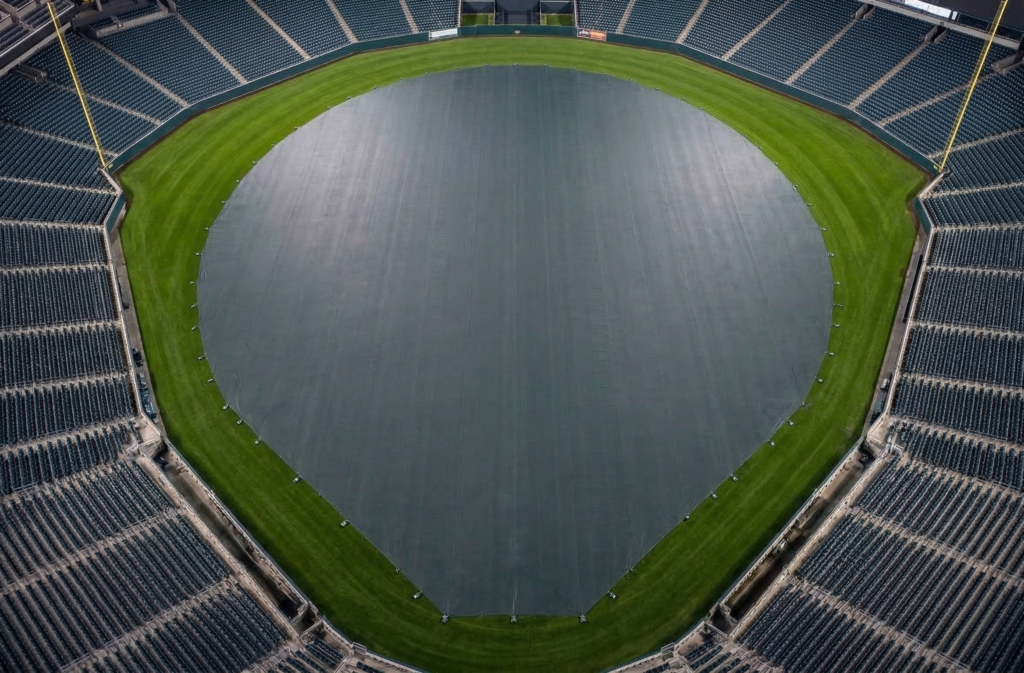
Field cover products vary widely in application. Here is how the Renegade lineup maps to typical cover product categories.
- Full-field football and soccer covers: PPI-420 is the primary specification: weight savings over 18 oz vinyl compound across a 60,000-square-foot football cover, reducing a six-person deployment to two.
- Baseball infield tarps and wind-weighted covers: Hydro-370‘s 2× abrasion advantage (ASTM D3389) makes it the right specification for any cover dragged across infield dirt daily. Burst strength also resists damage from cleated foot traffic at cover edges.
- Event conversion covers ( foot traffic surfaces): Any cover product walked on during events requires surface traction. PPI-370 Embossed at 11.2 oz provides anti-slip performance for high-foot-traffic applications: concert venue covers, graduation floor protection, multi-purpose turf overlays. Where flexibility and conformability to irregular surfaces matter more than structural weight, Flex-320 Embossed‘s mono-material PP construction and flexible embossed finish is the appropriate specification.
- Sideline protectors, track covers, and portable mats: PPI-270 at 7.7 oz keeps finished product weight low enough for single-person deployment. Where traction is also required ( sideline mats in wet conditions, dugout covers), PPI-370 Embossed provides the anti-slip surface at a weight still manageable by a two-person crew.
- Mound covers and plate covers: PPI-200 at 5.9 oz is a single-person product that stores in a fraction of the space a vinyl equivalent requires. PPI-270 is the step-up where slightly more structural weight is needed.
- Event conversion and turf regeneration covers (light-sensitive applications): Renegade’s Translucent Fabrics provide weather and moisture management while allowing light transmission that sustains turf health under extended coverage. This is a product category where opaque alternatives cause active agronomic damage.
Want to Know How Much Coverage You Need? Find the Size That’ll Never Come Up Short
Getting the right size of field cover is integral to successfully protecting an athletic field. Below are recommended sizes for various field types:
| Field Type | Typical Coverage Area (Sq. Yds.) | Recommended Tarp Coverage |
| Baseball Infield Only | 1,333 – 2,000 sq. yds. | Infield tarp sized to protect dirt, bases, and pitcher’s mound (approx. 1,400 – 2,100 sq. yds.) |
| Full Baseball Field | 10,000 – 13,333 sq. yds. | Custom full-field sports field cover for grass and infield protection (approx. 10,500 – 14,000 sq. yds.) |
| Softball Field (Infield) | 889 – 1,556 sq. yds. | Infield tarp with reinforced edges and grommets (approx. 950 – 1,650 sq. yds.) |
| Football Field (Regulation) | 6,400 sq. yds. (360′ x 160′) | Full football field cover with additional runoff margin (approx. 6,500 – 7,000 sq. yds.) |
| Soccer Field (Regulation) | 7,778 – 9,556 sq. yds. | Full-pitch turf cover with perimeter anchoring system (approx. 8,200 – 10,100 sq. yds.) |
| Multi-Use Athletic Field | 6,667 – 11,111+ sq. yds. | Custom-sized athletic field cover based on surface dimensions (approx. 7,000 – 11,700+ sq. yds.) |
5 Essential Qualifications to Look for in a Fabric Specification
When evaluating coated fabrics for field cover applications, these are the specifications that determine real-world product life:
- Abrasion resistance with a test standard attached: ASTM D3389 is the relevant method for infield tarps. Hydro-370‘s 2× advantage over standard coated fabric is a measurable starting point.
- Surface traction for walked-on covers: A cover product that gets deployed in any scenario where people walk on it requires a documented surface texture. Ask for anti-slip test data or at minimum a description of the emboss pattern. Smooth fabrics, however durable, are not a safe specification for event conversion products in wet conditions.
- Cold-temperature flex behavior: Ask for brittleness temperature data. For covers deployed in climates that drop below 20°F, PVC plasticizer behavior is the primary failure predictor. Polypropylene-based fabrics across the Renegade lineup do not carry this limitation.
- Light transmission for turf covers: For any cover used on natural grass for more than 24 hours, confirm whether the fabric allows meaningful light transmission. Renegade’s Translucent Fabrics are the specification for this requirement. Opaque fabrics are not a substitute regardless of other properties.
- Weight per yard: The Renegade lineup spans 5.9 oz (PPI-200) to 11.7 oz (PPI-420), which means fabric weight can be matched to deployment context rather than defaulting to a heavy specification across every product category.
Verified Performance: Certifications & Compliance that Back Up Our Materials
Polypropylene-based fabrics carry no California Proposition 65 warning, relevant for any cover product sold to facilities in California or to buyers with chemical exposure standards. PPI-270‘s FR version complies with California Fire Marshal Title 19 and meets European Toy Safety Code EN71-3 2019.
Flex-320 Embossed‘s mono-material PP construction (no plasticizers, rubberizers, or elastomers) makes it fully recyclable as a single-material stream, which addresses end-of-life requirements at venues with sustainability mandates. FR formulations are available across the lineup for indoor and covered stadium applications.
The Speed & Ease of Deployment: Where the Weight Savings Compound
The economics of a lighter cover compound across every deployment. A grounds crew at a college baseball facility that deploys and removes the infield tarp 60 times per season accumulates hours of labor difference between a PVC tarp and a polypropylene equivalent. Plus, reduced crew fatigue directly translates to fewer handling errors and longer cover life.
At the light end of the lineup, the advantage is more pronounced.
- A mound cover built on PPI-200 at 5.9 oz is a one-person product in every weather condition.
- A sideline protector on PPI-270 can be repositioned by a single crew member between series.
- An event conversion cover on Flex-320 Embossed or PPI-370 Embossed provides crew-safe traction on the surface they’re walking while they deploy it.
Storage compounds in the same direction. Lighter covers roll tighter, store in smaller enclosures, and create less stress at the roll core where concentrated pressure accelerates delamination in layered vinyl constructions.
The 7 Field Tarp Questions Coaches & Grounds Crews Ask Most
The right field cover does more than just block rain: it manages light, moisture, and mechanical stress. These answers address the high-stakes technical requirements that grounds crews and athletic directors need to keep their surfaces in championship condition:
- How long should a high-quality sports field cover last under regular use? A well-specified polypropylene cover under regular season use (e.g. daily deployment and removal during game season, outdoor storage in the off-season) should perform for 8 to 12 years before seam or surface degradation becomes a replacement trigger. PVC covers in the same conditions typically run 5 to 7 years before coating delamination or cold-cracking requires replacement.
- What thickness is recommended for a full baseball field tarp versus an infield-only cover? For full-field tarps, PPI-420 (11.7 oz) provides the structural weight to resist wind uplift. For infield-only covers deployed daily, Hydro-370 (11.2 oz) balances abrasion resistance and deployment weight. Mound and plate covers work well on PPI-200 or PPI-270 depending on structural weight requirements.
- Which fabric is right for event covers that get walked on? Any cover product deployed for events where crew or attendees walk on the surface requires an embossed specification. PPI-370 Embossed at 11.2 oz is the workhorse specification for high-foot-traffic event covers.
Where flexibility and conformability to irregular surface transitions matter more than structural weight, Flex-320 Embossed provides the anti-slip embossed surface in a more flexible, mono-material PP construction. Smooth fabrics, regardless of other performance properties, are not a safe specification for event conversion products in wet conditions. - How do you prevent wind uplift on large football field covers? Wind uplift management is primarily a product design problem: fabric selection affects the solution but doesn’t solve it alone. The durable long-term approach is fabric with sufficient tensile strength to hold securing loops and ballast attachment points without tearing. This is something both PPI-420 and Hydro-370 deliver at weights well below traditional PVC equivalents.
- Do translucent field covers actually keep grass alive under extended coverage? They slow the degradation significantly. Renegade’s Translucent Fabrics allow enough diffuse light transmission to sustain minimal photosynthesis during the 48-96 hour window where opaque covers cause visible yellowing on cool-season grasses.
For winter turf blankets and spring regeneration covers, the light transmission advantage compounds over weeks: fields under translucent covers in March recover measurably faster than fields under opaque alternatives in most northern climate conditions. - What’s the best way to dry a field tarp before it’s stored? Polypropylene covers dry faster than PVC or polyester because polypropylene is non-absorbent: water doesn’t penetrate the fiber, it sits on the surface and drains. A brief hang or fan-dry cycle after removal clears surface moisture. Polypropylene’s non-absorbent chemistry is naturally resistant to mold and mildew, extending usable storage life compared to PVC covers that trap moisture at the coating interface.
- Are sports field covers safe to use on synthetic turf surfaces? Polypropylene-based covers are among the safest options for synthetic turf because there is no vinyl coating that can transfer plasticizer chemistry onto the turf pile under heat and pressure.
For facilities running covers on artificial turf during events or for extended winter protection, material safety is a genuine specification concern.And polypropylene eliminates it.
Building Better Field Covers Starts with Smarter Material Selection
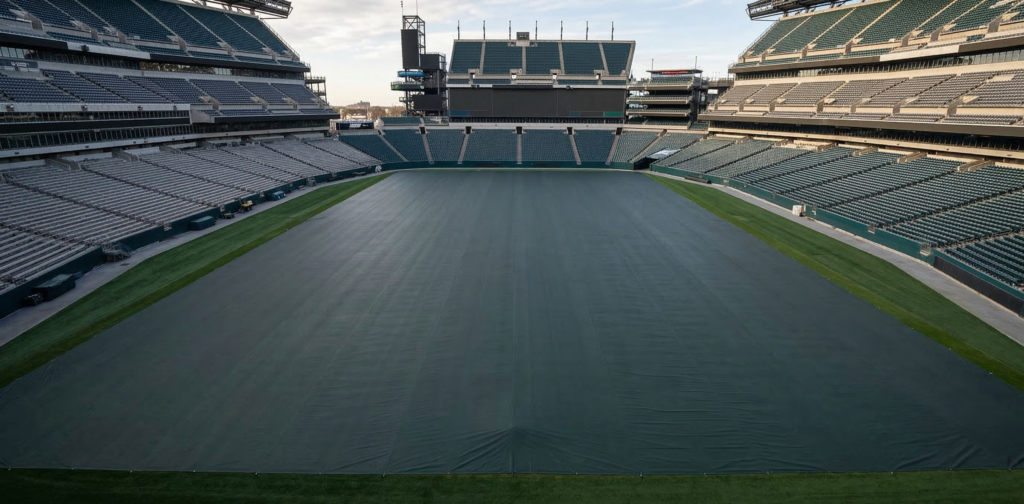
The field cover market is not underserved with product options.
It is underserved with material options that let manufacturers compete on performance rather than price-per-square-foot. Grounds directors managing professional, collegiate, and high-use amateur facilities are increasingly aware of what material chemistry means for their crews and their fields… and they are asking their suppliers for answers that PVC cannot give them.
Renegade maintains stock of PPI-200, PPI-270, PPI-370, PPI-370 Embossed, PPI-420, Flex-320 Embossed, Hydro-370, and Translucent Fabrics at its distribution center in Green Bay, Wisconsin, with standard orders shipping within a few business days. Request samples, run your own abrasion and burst tests against your current fabric specification, and bring the numbers back.
The case for switching builds itself. Contact our team today or call us at 920-348-4554 to learn more.