
Find Hay Tarps That Protect Your Stack Without the Toxic Trade-Offs
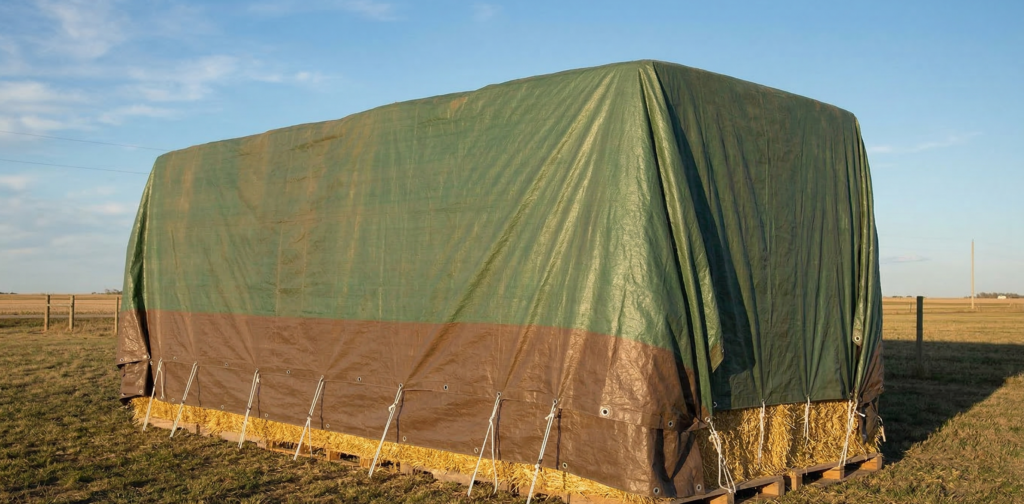
A hay producer storing 400 large round bales each fall loses 8 inches of weathered outer layer from every bale that spent the winter uncovered on bare ground. University research puts that spoilage between $5 and $8 per bale. By spring, that’s a preventable $2,000 to $3,000 loss (average) before a single bale reaches the feed bunk.
The solution isn’t complicated.
A properly selected hay tarp, sized and secured correctly, can cut dry matter losses by more than half. But “right” matters more than most buyers realize. Not all tarps protect hay equally, and some introduce a problem worse than weather.
4 Ways to Guard Your Hay from the Elements: Which Is Right for You?
The tarp you need depends on how your hay is packed and where it sits. Each configuration has different coverage requirements.
- Round bale tarps cover cylindrical bales stored outside, typically stacked pyramid-style in rows. Round bales shed water better than rectangular bales when properly wrapped or covered, but the curved surface means a tarp needs enough length to reach ground on both sides with overlap at the hem.
- Square bale tarps cover rectangular bales, which pack more efficiently into storage rows but absorb moisture more readily than round bales. Square bale coverage benefits from tarps that extend past every edge of the stack, since flat surfaces collect standing water if the cover sags in the center.
- Stack and windrow covers protect multiple rows of bales in large operations. These are typically larger custom-cut tarps, often in the 44′ x 22′ or 60′ x 40′ range, positioned to create a ridge so water runs off rather than pooling.
- Hay shed tarps and temporary structure covers serve operations without permanent barn space. A heavy-duty tarp stretched over a simple frame extends hay shelf life at a fraction of permanent construction cost. Iowa State Extension research notes that barn construction typically runs $2 to $6 per square foot, with payback periods spanning years. A tarp provides meaningful protection as a practical near-term option.
10 Benefits of Covering Hay with the Right Tarp & How They Protect Your Bottom Line
University and extension research consistently shows (see below) that covered hay outperforms uncovered hay on every measurable dimension, from dry matter retention to relative feed value. Here’s what that data means for your operation.
- Reduces dry matter loss and preserves nutritional value: University of Minnesota research on bale storage found that covered bales on gravel averaged 4.8 percent dry matter loss over eight months, compared to 10.9 percent for uncovered bales on gravel. Oklahoma research showed an even wider gap: 2 percent loss for covered storage on pallets versus 13.1 percent for uncovered storage on bare ground. (University of Minnesota Extension)
- Protects against rain, snow, and moisture damage: Moisture is the primary driver of hay spoilage. Once stored hay exceeds 20 percent moisture, mold and bacterial degradation accelerate rapidly. That degraded outer layer is typically refused by livestock entirely. (Mississippi State University Extension)
- Shields hay from UV degradation and heat: Direct sun exposure breaks down plant proteins and degrades the outer layers even without rainfall. A UV-resistant tarp limits this secondary form of loss, which compounds over months of outdoor storage.
- Prevents mold, rot, and bacteria growth: Mississippi State Extension research links hay baled above 20 percent moisture directly to mold formation. Tarp coverage keeps ambient moisture from rewetting properly cured hay after baling. Moldy hay can be detrimental to livestock health. (Mississippi State University Extension)
- Extends hay shelf life between cuttings and seasons: The University of Minnesota Morris study found that bales stored uncovered on sod developed internal moisture levels of up to 32 percent by June, well above the threshold for significant spoilage. Covered bales on gravel maintained far lower moisture levels across the same storage window. (University of Minnesota Extension)
- Maintains or increases market value of tarped hay: The Minnesota study measured relative feed value (RFV) for each storage method. Bales stored inside a shed showed an RFV of 133; bales stored uncovered outside on sod showed external RFV values as low as 55. That 78-point spread represents real market value when hay is priced or sold. (University of Minnesota Extension)
- Eliminates costly re-baling or hay replacement: Mississippi State calculates that improperly stored hay can cost a rancher with 30 cows an additional $1,200 to $4,000 per year in harvest or purchase costs alone, just replacing what deteriorated .(Mississippi State University Extension)
- Reduces reliance on expensive permanent barn storage: Barns cost $2 to $6 per square foot to build, with payback periods that span years. A tarp provides meaningful protection at a fraction of that upfront investment, making it especially practical for operations managing storage across multiple sites or fields.
- Keeps hay ready for livestock feeding without quality loss: Weathered hay is regularly refused by livestock because palatability drops sharply when the outer layer has degraded. Covered hay maintains the palatability of its internal structure, reducing waste at the feed bunk.
- Recyclable tarp materials reduce long-term waste and disposal costs: Polypropylene-based tarps like those from Renegade Plastics can be returned for recycling at end of life through Renegade’s take-back program rather than piling up in landfills.
2 Tests to See If a Heavy-Duty Hay Tarp is Cost Effective
A tarp’s price per square foot doesn’t capture its cost per bale protected. The calculation that matters: how many seasons will this tarp last, and what will it protect in that time?
- The Durability Test: Heavy-duty polypropylene fabrics, like Renegade’s PPI-270 through PPI-420, are built to maintain UV resistance, waterproofing, and structural integrity across multiple seasons of outdoor exposure. They’re also roughly 40 percent lighter than comparable vinyl tarps, which matters when one person needs to deploy a tarp over a large stack before a storm.
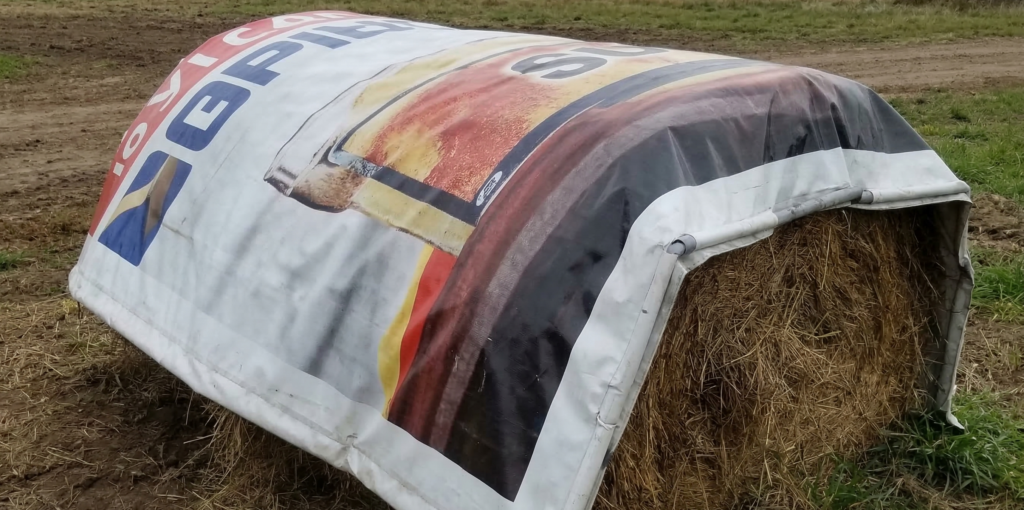
The durability gap between materials shows up most in three scenarios: extended storage beyond 90 days, high-UV environments in western and southern states, and operations where the same tarp gets removed and reinstalled repeatedly across cuttings. Standard polyethylene tarps, the kind sold cheaply at hardware chains, tend to fail at the grommets first, often mid-season. - The Toxicity Test: Reclaimed vinyl billboard material has become a common low-cost option for hay coverage. The appeal is real: billboard vinyl is heavy, waterproof, and cheap to acquire. The problem is what that vinyl does over time.
PVC (polyvinyl chloride), the material most billboard signage is made from, requires phthalate plasticizers to stay flexible. Unlike PVC itself, phthalates are not chemically bound to the material. They leach, migrate, and evaporate from the surface over time. When a billboard vinyl tarp sits on a hay stack through heat cycles across a season, that migration happens into the hay beneath it.
The U.S. EPA cites specific concern about phthalates’ toxicity and their role as endocrine disruptors, particularly their interference with hormone production including testosterone. (U.S. EPA Phthalates Biomonitoring) Peer-reviewed research published in *Frontiers in Veterinary Science* identifies phthalates including DEHP as endocrine disruptors in domestic animals, with reproductive effects documented in cattle and other livestock. (Magnusson & Persson, 2015, PMC)
Animals fed hay stored under billboard vinyl tarps ingest those residues. The pitch for billboard tarps is economy. The cost of reproductive problems or illness in a herd is not a line item most operations absorb quietly.
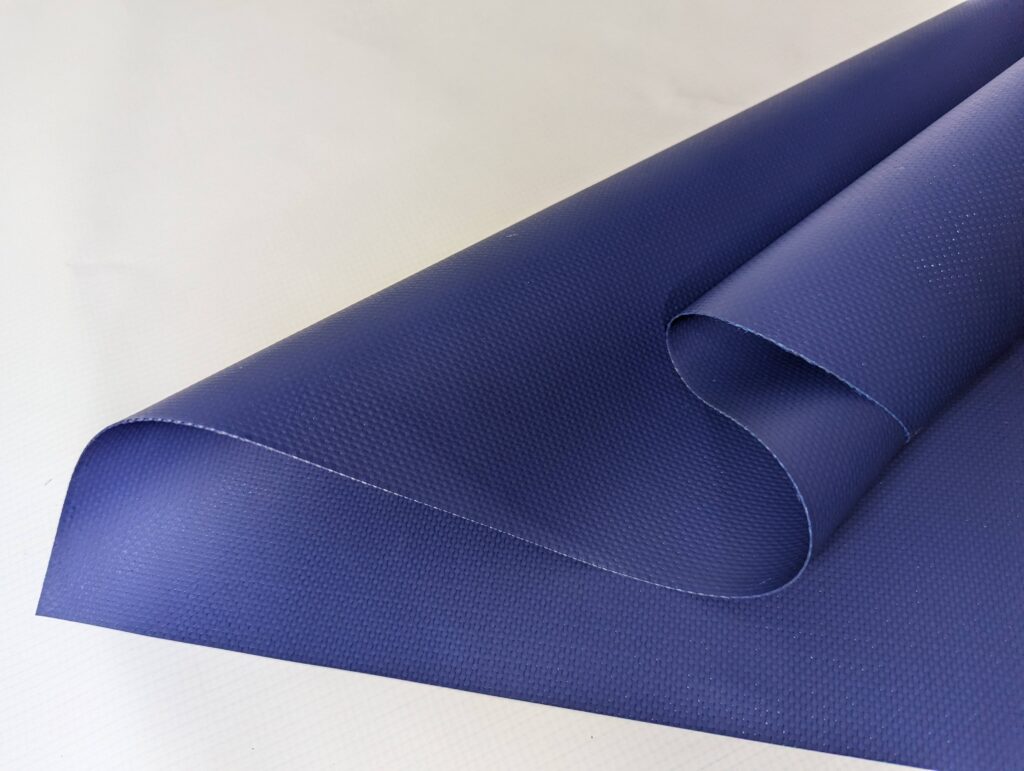
Renegade tarps contain no phthalates, no PVC, no PFAS, and no BPA. The material is a patent-pending polypropylene that doesn’t require plasticizer additives to remain flexible, so there’s nothing to leach.
The 4 Best Fabrics for Hay Tarps: Sizes, Weights, & Recommended Uses
Renegade produces four core fabrics suited to hay tarp applications, matched to different scales of operation and storage duration. All are free of PVC, phthalates, PFAS, and BPA.
| Option | Weight | Best For | Type |
| PPI-200 | 5.9 oz/sq yd (200 g/m²) | Smaller stacks or short-term coverage | Custom Order |
| PPI-270 | 7.7 oz/sq yd (270 g/m²) | General-purpose square or round bale covering | Custom Order |
| PPI-370 | 11.2 oz/sq yd (370 g/m²) | Large stacks, extended outdoor exposure, commercial operations | Custom Order |
| PPI-420 | 11.7 oz/sq yd (420 g/m²) | Super heavy duty: large stacks, extended outdoor exposure | Custom Order |
Ready-to-ship contractor-grade tarps are also available for immediate coverage needs:
| Option | Size | Best For | Type |
| Mini Tarp | Mini | Single bales, spot coverage | Ready to Ship |
| 8′ x 6′ Tarp | 8′ x 6′ | Single bales, quick cover | Ready to Ship |
| 10′ x 8′ Tarp | 10′ x 8′ | Small square bale stacks | Ready to Ship |
| 10′ x 10′ Tarp | 10′ x 10′ | Compact square stacks | Ready to Ship |
| 12′ x 9′ Tarp | 12′ x 9′ | Mid-size hay stacks | Ready to Ship |
| 20′ x 12′ Tarp | 20′ x 12′ | Larger stacks, drop cloth use | Ready to Ship |
| Industrial Tarp 44′ x 22′ | 44′ x 22′ | Industrial-scale hay coverage | Ready to Ship |
| Industrial Tarp 60′ x 40′ | 60′ x 40′ | Large commercial hay operations | Ready to Ship |
All tarps made from Renegade materials are rated NSF 61 drinking water safe, which reflects its safety profile in food-adjacent applications( including hay stored for livestock). The PPI-370 and PPI-420 replace 16 to 18 ounce vinyl fabrics at 11 to 12 ounces per square yard, which is significantly lighter without sacrificing performance for large-scale commercial operations.
Ground to Hem: How to Properly Protect a Hay Stack from Every Angle
A tarp that doesn’t reach the ground doesn’t fully protect the stack. Water running off the sides pools at the base, exactly where moisture enters bales most readily.
The standard method for covering a rectangular hay stack: position the tarp so it extends past every edge with enough overhang that the hem contacts the ground. From there, secure with one of these methods:
- Rope or bungee tie-down systems run under the bales or around perimeter stakes
- Rebar or PVC pipe threaded through tarp grommets and driven into the ground at angles
- Weight bags or sandbags placed along the hem for lower-profile stacks in exposed locations
For large round bale stacks stored pyramid-style, aim for an “A-frame” effect: a center ridge that sheds precipitation to both sides. A tarp that sags in the middle will hold standing water, which finds grommets and edges and delivers moisture directly to the hay.
Renegade grommets are welded rather than mechanically fastened and are made from the same polypropylene as the tarp body. Because the grommet and tarp share the same material, they have comparable tensile strength. When a tie-down load pulls on a grommet, it doesn’t rip out the way a metal grommet sewn into a different material would.
If your hay stays tarped through the winter, check tie-downs after heavy snow. Snow load can shift even well-anchored tarps, and a gap that opens in December can let weeks of moisture reach the bales before anyone inspects the stack.
3 Other Uses for Hay Tarps You Might Not Have Considered
Once you’ve invested in a heavy-duty tarp, the use cases tend to multiply. The same UV resistance and weatherproofing that protects hay holds up just as well in these three applications.
- Silage Covers: Silage tarps share the same physical requirements as hay tarps — UV resistance, waterproofing, and structural durability — but silage applications often require additional surface coatings to manage the anaerobic fermentation environment in pits or bunkers. Renegade fabrics can be specified with custom coatings through direct consultation with the sales team.
- Grain pile covers: Outdoor grain storage under heavy-duty tarps uses the same UV-resistant, waterproof fabric as hay coverage. The primary difference is geometry: grain pile tarps tend to be larger and need to accommodate a conical pile shape. The 44′ x 22′ and 60′ x 40′ sizes cover commercial-scale operations.
- Equipment Storage: Farmers purchasing hay tarps often use similar products to cover tractors, implements, and other equipment during off-season storage. The same UV resistance and weatherproofing that protects hay works equally well on painted metal, rubber, and exposed electronics.
Before You Purchase: Get Your Top 4 Hay Tarp Questions Answered
The right tarp purchase starts with the right information. These four questions cover the material, the application, and what happens at the end of the tarp’s life.
- What is the typical lifespan of a Renegade fabric? Renegade fabrics are designed for multi-season outdoor use. The polypropylene base maintains UV resistance without the cracking or chalking that shortens the life of standard polyethylene tarps. Actual lifespan depends on UV intensity, frequency of use, and how the tarp is stored between uses. Contact the Renegade sales team for guidance based on your specific application.
- Can I use hay tarps on ground-level stacks, or do I need an underlayment? Elevating bales off bare ground reduces moisture absorption significantly. University of Minnesota and Mississippi State research both show that bales in direct contact with soil absorb enough moisture to cause spoilage regardless of top covering. Gravel, pallets, or tires combined with tarp coverage produce the best results. For short storage windows on well-drained soil, ground-level tarp coverage may be acceptable, but elevation remains the more reliable approach.
- Are Renegade hay tarps safe around livestock and food-grade hay? Renegade tarps contain no phthalates, no PVC, no PFAS, and no BPA — the chemical classes most commonly linked to contamination risk in agricultural applications. Renegade materials carry NSF 61 certification and the OECD 203 Acute Toxicity certification (fish grade), reflecting its appropriateness in food-adjacent environments.
- Can Renegade fabrics be recycled at the end of its life? Yes. Renegade’s polypropylene material is accepted by over 60 percent of U.S. plastic recycling facilities. Renegade also runs a direct take-back recycling program: when it’s time to replace a tarp, the original storage bag becomes the return shipping parcel. Renegade handles routing to recycling partners from there.
Ready to Cover Smarter? Choose a High-Quality Hay Tarp Built to Last
Hay that doesn’t reach the feed bunk represents real loss. University research puts preventable dry matter losses at 6 to 11 percent for covered versus uncovered storage, and that gap compounds across hundreds of bales and multiple seasons.
The tarp question isn’t only about coverage area. It’s about what the covering material brings with it. PVC and billboard vinyl carry phthalates that have no place near livestock feed. Thin polyethylene tarps that fail at the grommets or crack in cold weather aren’t protecting the investment; they’re adding disposal costs.
Renegade tarps protect the stack and leave the chemistry out of it.
| Option | Size | Best For | Type |
| Mini Tarp | Mini | Single bales, spot coverage | Ready to Ship |
| 8′ x 6′ Tarp | 8′ x 6′ | Single bales, quick cover | Ready to Ship |
| 10′ x 8′ Tarp | 10′ x 8′ | Small square bale stacks | Ready to Ship |
| 10′ x 10′ Tarp | 10′ x 10′ | Compact square stacks | Ready to Ship |
| 12′ x 9′ Tarp | 12′ x 9′ | Mid-size hay stacks | Ready to Ship |
| 20′ x 12′ Tarp | 20′ x 12′ | Larger stacks, drop cloth use | Ready to Ship |
| Industrial Tarp 44′ x 22′ | 44′ x 22′ | Industrial-scale hay coverage | Ready to Ship |
| Industrial Tarp 60′ x 40′ | 60′ x 40′ | Large commercial hay operations | Ready to Ship |
| PPI-200 | Custom | Smaller stacks, short-term coverage | Custom Order |
| PPI-270 | Custom | General-purpose square or round bale covering | Custom Order |
| PPI-370 | Custom | Large stacks, extended outdoor exposure | Custom Order |
| PPI-420 | Custom | Super heavy duty: large stacks, extended outdoor exposure | Custom Order |
Contact us to get a quote, ask about custom sizing, or find the right fabric for your operation.